A border that flowers all year
Every month can have something in flower, though most months will only have a little. Of the plants here that suit UK gardens, 265 are in flower in July and 12 in January. Four carry December. So the target is a border where every month has at least one thing worth walking out to look at.
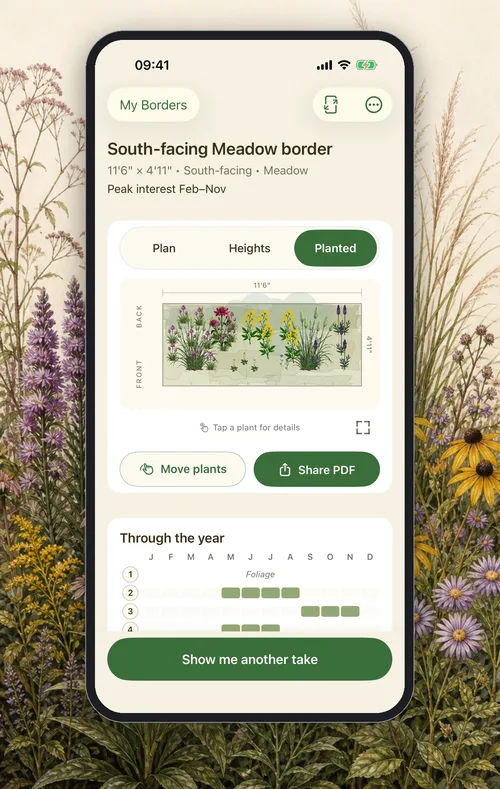
What all year means
Aim for two things in flower per month rather than one, because a single plant covering a month will let you down the year it sulks or the year the weather is odd. Then accept that the winter months are carried by shrubs and bulbs, the spring by bulbs and blossom, and the summer by perennials that are all trying to flower at once.
The screenshot above is the planted view, and the strip along the bottom is the through-the-year check. A month with nothing in it shows up straight away there, which is much harder to see on a list of plant labels.
Month by month
Everything named here is in the catalogue with those flowering months recorded against it. Find the one or two rows you have nothing for and start there, rather than reading the table as a shopping list.
| Month | What carries it | Plants |
|---|---|---|
| January | Winter shrubs and the first bulbs | Witch Hazel 'Pallida' (Jan to Feb), Sweet Box (Jan to Feb), Snowdrop (Jan to Feb) |
| February | Hellebores and the early daffodils | Hellebore (Jan to Apr), Daffodil 'Tete-a-Tete' (Feb to Mar), Bergenia 'Purpurea' (Feb to Apr) |
| March | Bulbs and the first shrubs | Star Magnolia (Mar to Apr), Flowering Currant 'King Edward VII' (Mar to Apr), Lungwort 'Diana Clare' (Feb to May) |
| April | Blossom and the main bulb flush | Snowy Mespilus (Apr), Wild Daffodil (Mar to Apr), Bleeding Heart (Apr to Jun) |
| May | Shrubs, mostly | Lilac 'Charles Joly' (May to Jun), Mountain clematis (May to Jun), Solomon's Seal (May to Jun) |
| June | Roses and the first perennials | Rose 'Munstead Wood' (Jun to Sep), Foxglove (Jun to Jul), Lady's Mantle (Jun to Aug) |
| July | Perennials at full stretch | Phlox 'David' (Jul to Sep), Crocosmia 'Lucifer' (Jul to Aug), Hydrangea 'Limelight' (Jul to Oct) |
| August | Late perennials and summer shrubs | Japanese Anemone 'Honorine Jobert' (Aug to Oct), Butterfly Bush (Jul to Sep), Tall Verbena (Jun to Oct) |
| September | Asters and grasses | New England Aster 'Harrington's Pink' (Sep to Oct), Silver Grass 'Morning Light' (Sep to Oct), Guernsey Lily (Sep to Nov) |
| October | Autumn bulbs and the last perennials | Hardy Cyclamen (Sep to Nov), Crimson flag lily 'Pink Princess' (Sep to Nov), Switchgrass 'Cloud Nine' (Aug to Oct) |
| November | The winter shrubs starting up | Mahonia 'Charity' (Nov to Feb), Camellia (Oct to Dec), Compact Strawberry Tree (Oct to Dec) |
| December | Four shrubs | Viburnum tinus 'Eve Price' (Dec to Apr), Mahonia 'Charity' (Nov to Feb), Compact Strawberry Tree (Oct to Dec), Camellia (Oct to Dec) |
Evergreen structure is the winter frame
Flowers are the smaller half of this. From November to March what you are looking at is shape, and shape comes from evergreens. English Yew (Taxus baccata) at 400 cm (4 m) by 300 cm, clipped into a block behind the bed, does more for the winter view than any winter-flowering plant will. Viburnum tinus 'Eve Price' at 200 cm by 200 cm manages both at once, evergreen and in flower December to April. At the front, Hellebore (Helleborus x hybridus) and Bergenia 'Purpurea' are both evergreen at 45 cm, so the edge of the bed keeps a line in it through winter instead of reverting to bare soil.
A quarter to a third of the planting evergreen is about right. Below that the bed disappears in November. Much above it and the border stops changing through the year.
The gaps most borders have
Few plants flower in December and January at all. Only so many plants flower in December and January, and the good ones are shrubs, so they need room at the back and cost more than a tray of perennials. Mahonia 'Charity' (Mahonia x media 'Charity') at 250 cm by 250 cm from November to February does the most work of any of them. Witch Hazel 'Pallida' (Hamamelis x intermedia 'Pallida') at 300 cm by 300 cm in January and February wants acid or neutral soil and space, so it takes a decision about the whole bed, and the same acid soil condition applies to Camellia from October to December. Sweet Box (Sarcococca confusa) at 150 cm by 100 cm is the easiest of them and the one to put near a door, since the scent is the point.
The late summer dip is a buying problem rather than a plant problem. People shop in spring, and nothing that flowers in September is in flower on the bench in April, so nobody buys it. The catalogue has 175 plants for September against 265 for July, which is plenty to choose from. Japanese Anemone 'Honorine Jobert' (Anemone x hybrida 'Honorine Jobert') and New England Aster 'Harrington's Pink' (Symphyotrichum novae-angliae 'Harrington's Pink') between them cover August into October, and Hydrangea 'Limelight' (Hydrangea paniculata 'Limelight') holds from July all the way through. Buy them in September, when you can see what you are actually getting.
How to check a plan before you buy
Write the twelve months down the side of a page and mark each plant's flowering months against them. It takes ten minutes and it is the most useful thing you can do before spending money, because the holes show up on the page.
A month covered by one plant is a month that fails if that plant has a bad year, so push for two. And a plant listed as flowering June to October will not be at full tilt in October, since the recorded months are the range rather than the peak. The last month of a long run is usually a few flowers rather than a display, so treat the end of the season as thinner than the table makes it look.
- Sweet BoxSarcococca confusa
- HelleboreHelleborus x hybridus
- Daffodil 'Tete-a-Tete'Narcissus 'Tete-a-Tete'
- Rose 'Munstead Wood'Rosa 'Munstead Wood'
- Japanese Anemone 'Honorine Jobert'Anemone x hybrida 'Honorine Jobert'
- New England Aster 'Harrington's Pink'Symphyotrichum novae-angliae 'Harrington's Pink'
- Mahonia 'Charity'Mahonia x media 'Charity'
- Viburnum tinus 'Eve Price'Viburnum tinus 'Eve Price'
Border Builder does this for your own bed: enter its size, aspect and soil and it draws up the plan.