How to plan a garden border
Most disappointing borders were bought before they were planned. You come home with nine plants that looked good on the bench, they all flower in June, and by mid-August the bed is a wall of green. Planning it first takes about an hour.
Four decisions come before any plant. How big the bed is, which way it faces, what the soil does, and what you want it to look like. One bed runs through this guide, 6 m by 2.5 m, facing south, in a loose cottage style.
Measure the bed
Length along the front, depth from the front edge to whatever is behind it. Depth decides more than length does. A bed 40 cm deep holds one row of small plants. At 2.5 m there is room for a shrub with something in front of it and something in front of that.
Work out which way it faces
Stand in the bed with your back to the fence and look out. The direction you are looking is the aspect, and a phone compass settles it. Then count the sun on a clear day, mid-morning, lunchtime and late afternoon. Six hours or more is full sun, three or four is partial shade, and under two hours is shade, which needs a different plant list.
Find out what the soil is
Dig a hole a spade deep, take a handful from halfway down, wet it and squeeze. Clay holds the shape of your fingers and rolls into a sausage that takes a shine. Sand grits between the fingers and falls apart. Chalk is pale and full of small white stones. Loam holds together and breaks up when you poke it.
Then test the drainage. Fill a hole 30 cm across and 30 cm deep with water, let it soak away, and fill it again. If the second filling is still there after four hours the bed is wet, which rules out more plants than the sun does. Clay sets hard in a dry July and sand runs out of food by midsummer. Chalk is alkaline, so acid-lovers go yellow.
Choose a style
Style decides how much work the bed is. Cottage borders are dense and want deadheading and staking. Formal planting leans on clipped evergreens. One gap in a formal scheme shows from the house. Modern borders use fewer species in bigger drifts, so less work and less flower. Wildlife borders keep seedheads standing and look scruffy from November. Mediterranean planting needs sharp drainage and rots in wet clay. Woodland planting goes quiet from July.
The aspect and the soil choose the style as much as you do. A north-facing bed on heavy clay makes a good woodland border, and Mediterranean planting on that bed will rot.
Three layers, back to front
A border reads as three bands, the structure at the back, the flowering middle and a low front edge. Here the back gets 1 m, the middle 1 m and the front 50 cm. Tall things go behind because you take a border in all at once, and a 1.5 m perennial at the front hides everything for five months. An island bed seen from all sides is tallest down the middle.
The back is one Lilac 'Charles Joly' (Syringa vulgaris 'Charles Joly') at 400 cm (4 m) tall and 300 cm across, and one Hydrangea 'Limelight' (Hydrangea paniculata 'Limelight') at 200 cm by 200 cm. Two plants fill 5 m of the 6 m back, the lilac flowering May and June, the hydrangea July to October.
The middle takes Rose 'Munstead Wood' (Rosa 'Munstead Wood') at 100 cm by 90 cm for June to September, Crocosmia 'Lucifer' at 120 cm by 60 cm for July and August, and Phlox 'David' (Phlox paniculata 'David') at 100 cm by 60 cm for July to September.
The front is Lavender 'Munstead' (Lavandula angustifolia 'Munstead'), 45 cm each way and evergreen, so the edge still has a shape in February. Hardy Geranium 'Rozanne' (Geranium 'Rozanne') is 50 cm tall and 100 cm across and flowers June to October.
- Lilac 'Charles Joly'Syringa vulgaris 'Charles Joly'
- Hydrangea 'Limelight'Hydrangea paniculata 'Limelight'
- Rose 'Munstead Wood'Rosa 'Munstead Wood'
- Crocosmia 'Lucifer'Crocosmia 'Lucifer'
- Phlox 'David'Phlox paniculata 'David'
- Yarrow 'Cerise Queen'Achillea millefolium 'Cerise Queen'
- Lavender 'Munstead'Lavandula angustifolia 'Munstead'
- Hardy Geranium 'Rozanne'Geranium 'Rozanne'
Work out how many to buy
Spacing is the mature spread, centre to centre. The front band is 6 m long, so lavender at 45 cm across gives 6 divided by 0.45, thirteen plants for an unbroken edge. How many plants a border needs works through it band by band, and Border Builder does the same counting from the measurements.
Check it flowers across the year
Write out the flowering months of everything on the list and look for the holes. This bed runs May and June from the lilac, June to September from the rose, and July to October from the hydrangea. So it covers May to October and then does nothing for six months. That is normal, and bulbs under the front planting and one evergreen at the back fix it. A border that flowers all year has the month by month version.
Buying and planting
Buy shrubs in a larger pot, since a 3 litre shrub is three years ahead of a 9 cm plug. Perennials work the other way, since a 9 cm one planted in spring usually catches a 2 litre one by its second summer.
Autumn planting suits most of the country, the soil still warm and the rain doing the watering. Dig the hole wider than the pot and no deeper, firm the plant in with your heel, water properly once rather than a little daily, and mulch the bed afterwards. Then leave the gaps alone, since a border at proper spacing is full by year three.
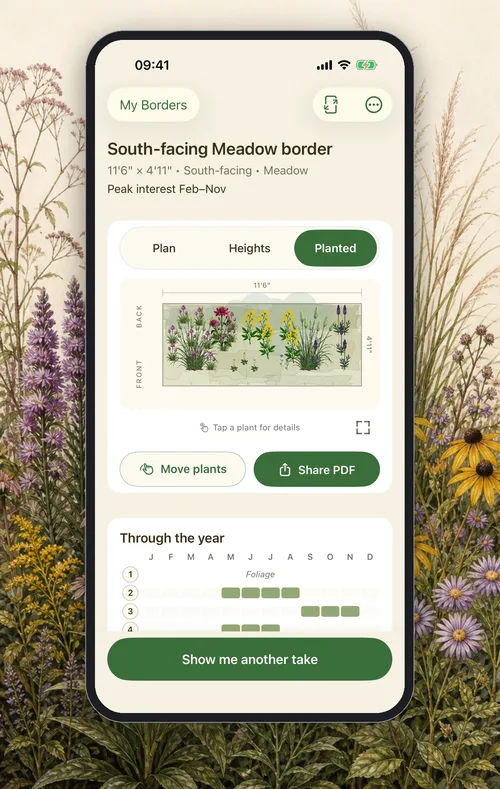
Border Builder does this for your own bed: enter its size, aspect and soil and it draws up the plan.